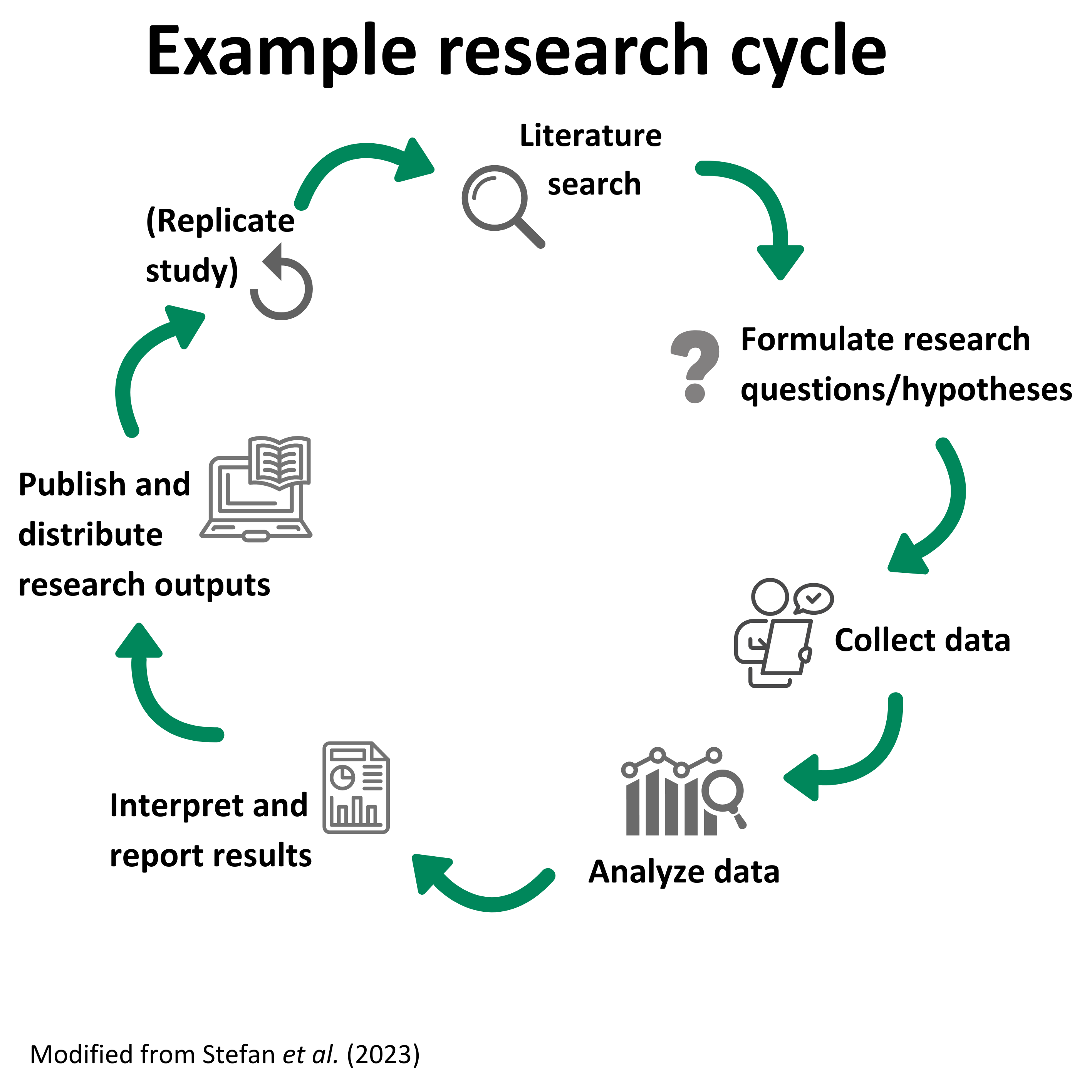
Research cycle
Where in the research life cycle we think about analyses influences how we interpret and report our findings. It is also important to think about the type of research approach of your study.
Research approaches 101
Qualitative research
Qualitative research approaches focus on examining the meanings, experiences, and perspectives of individuals or groups. Data collection involves primary, first-hand, text-based data that is analyzed using specific interpretive methods. Sometimes text-based data is ‘coded’ to identify key themes and patterns (Braun and Clarke 2006).
Review-based research
Review-based research involves collating and synthesizing previously published work on a topic. These approaches can be used to generate new insights and identify knowledge gaps. Reviews can be more or less done systematically, with systematic review and meta-analyses having well-established protocols (e.g. PRISMA guidelines).
Intervention and experimental research
Intervention and experimental research approaches are closely related. They involve deliberate manipulations to a physical entity (e.g. individuals, groups, organisms) intended to measure changes to that entity. Intervention studies typically focuses on the application of a treatment or action to observe its effect. In experimental studies, a researcher typically observes a problem or situation, then develops a testable hypothesis from which experiments under controlled conditions are used to test specific hypotheses. Based on the outcomes, the hypothesis is adapted. A hypothesis is an unproven statement relating the connection between variables.
Hypothesis generating vs testing are two modes of research inquiry that influence study designs and underpin the practice of study registrations. Hypothesis generating: - exploratory, discovery-focused research (asks questions like: what is happening? Why is it happening, How is it happening?)
Hypothesis testing: - confirmatory, justification-focused research (asks questions like: what does X do to Y?)
The distinctions between hypothesis generating vs testing research are often not clearly differentiated in practice, which leads to questionable research practices and reduced credibility of research.
Observational research
Observational research gathers information about individuals or populations without manipulating the environment or variables. Researchers observe and collect data on subjects as they naturally occur in their usual settings.
Mixed methods research
For research that adopts one or more theoretical frameworks (social and biological sciences) or data types (e.g. participant surveys, visual data, geospatial), would be described as a mixed-method approach.
Research approaches and preregistration
This page outlined five methodological and philosophical approaches to research sometimes referred to as “research paradigms”. Being able to recognize the different research approaches, study designs and key concepts will help provide context for the steps required to do a study preregistration. It is also good to be aware of other approaches to research from your own as it broadens your perspectives, especially in an increasingly interdisciplinary and collaborative research ecosystem (e.g. Big Team Science).
Which research approach do you use? Have you used more than one approach in your research journey?
The focus of this tutorial is more for hypothesis driven research. For additional guidance for preregistration of qualitative studies take a look at Haven et al. (2020).